
The Double Bind
The lose/lose scenario

It's a Sunday morning and Olivia is sitting with her mom at brunch. Olivia works as a freelancer and over the weekend she finally got a big contract signed with a new client. She was beaming on the inside about her big news - excited to see her business move forward and her skills be appreciated. She was also anxious inside. Worried that if she told her mom about the news that she would be disregarded or put down.
Listen while you read:
Olivia wanted to share the good news with her mother.. .and as her mother’s child, she knew it might not be a good idea. As she sat looking at the menu, she pondered her options - she could either share the news or keep it to herself. She decided it was best to keep it close to the chest.
And then her mom opened the door.
“So what’s new? How is everything going with work…and are you still working on that…what’s that thing you’re doing called again?”
“Graphic design?”
“Yeah yeah. That. Are you still working on that little project with graphic design?”
“I am”. Olivia shared tentatively. She wondered - is my mom asking me because she truly wants to know or is she being condescending?
The Double Bind
Olivia is experiencing something called “a double bind”. The double bind theory was developed by anthropologist Gregory Bateson and his research team in Palo Alto, California, the home of systemic frameworks (the way we think of how humans influence each other).
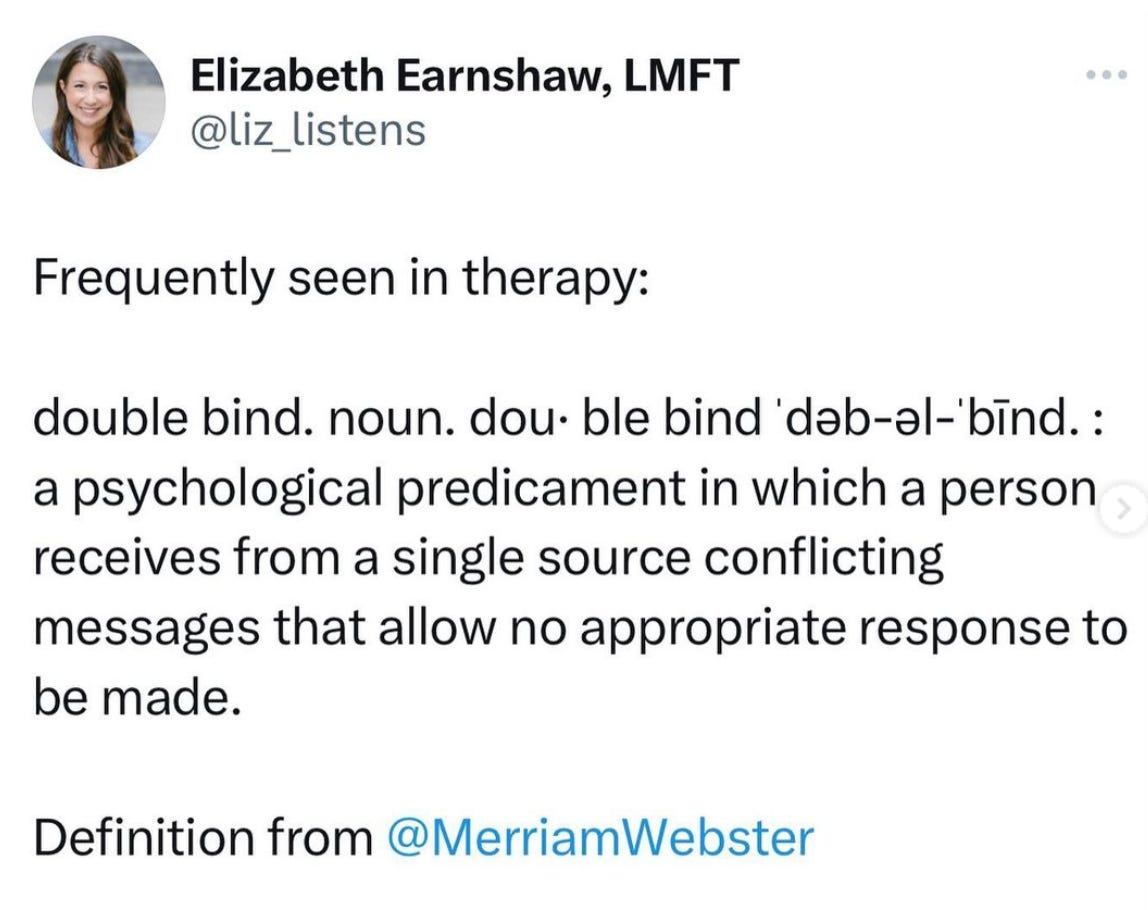
A double bind occurs when we are communicating with someone and receive conflicting messages. These messages are often sent in different manners - for example someone might say something with their words and say something else with their tone.
In these situations it doesn’t matter what you do because your response will be wrong. In simple terms double bind communication is a lose-lose scenario. But for the lose-lose scenario to cause significant emotional distress, it needs four components:
1. The person has to matter in some way to you
2. There needs to be a double message
3. The needs to be a sense of uncertainty regarding which message is true
4. No matter which message you decide is "true" the person will insist the other message was actually the truth.
Watch a video of double bind communication
The double message + uncertainty
Olivia had to ponder how to respond to her mom’s requests for more information about the project. On one hand, she was receiving the message that her mom was curious and interested in her. She had always yearned for that type of relationship.
On the other hand, her mom’s tone and use of “little business” indicated condescension and judgment. If she shared, her mom might put her down and she wanted to protect herself from that experience.
Olivia was receiving a double message and was uncertain on how to respond.
Of course this doesn’t only occur in mother/daughter relationships. This can also occur in the workplace, with friends, partner’s, and other family members.
A double message from a boss could be something like “Are you happy at work recently? You seem unhappy”. Perhaps you want to share with your boss that you have been unhappy and have an opportunity to problem solve what’s next. However, your boss is asking in a way that seems closed off and indicates anger towards you. You are uncertain about whether you should take your boss at face value and share how you’re feeling or go with your gut and avoid any punishment by sharing information he doesn’t want to hear.
Another example is a double message from your adult child. Perhaps you asked them if you could come over and visit and maybe they say “You can come over, if you really want”. Because you’ve not seen your child for awhile and have been waiting for the invitation, you feel eager to accept. But you might also hear hesitation or lack of enthusiasm in the message and wonder if they actually want you to say “nevermind, I won’t come”.
In both of these interactions the receiver of the message feels stuck - there are two messages here? Which do I respond to?
You’ll be wrong no matter what
A double bind, though, isn’t just about unclear messages. In fact, people send unclear messages all of the time. Depending on our mood, communication style, the relationship, and the topic we might accidentally miscommunicate or misread someone’s intention. A double bind requires one more step - that no matter how you answer you will be wrong.
Let’s look at how this plays out for Olivia and her mom:
If Olivia decides to believe that her mother is interested in her, she might choose to share:
“You know, the freelancing is going really well actually! I got a huge contract this weekend! I am really so excited and feel like this is finally the opportunity I needed to commit fully to this vision”.
Olivias mom rolls her eyes and says “Really? You think one contract is enough for that? Honey, really this is just such a little thing and it’s not going to work out how you think. I didn’t raise you to be so irresponsible”.
Olivia immediately realizes she answered wrong. That her initial inclination to protect herself and hold back on sharing was likely right. She feels internally confused and self critical.
But, if Olivia had chosen to listen to the other message - “my mom is being condescending” - she would have been wrong again:
“Mom, I really feel hesitant to share with you when you call my business ‘little’. It seems like you’re putting me down.”
“God. It’s impossible being your mother. Exhausting! I try and try and try to connect with you and you just don’t let me do it. You’re such a brat. So whatever. Don’t share with me. I don’t care.”
In this interaction, Olivia also feels internally confused. She believes she picked the wrong message and might feel guilty for blocking the connection she so deeply desired with her mom.
Read another example or skip to keep scrolling if you get the gist.
Let’s look at the interaction between boss and employee.
If the employee decides to believe that their boss is truly curious, the interaction might go like this:
Employee: “You know, I am so glad you asked. I would love to have a conversation about how I have been feeling lately and I hope we can come up with some solutions for moving forward. You’re right. I have been struggling and feeling a bit frustrated with how things have been going”.
Boss: “Are you kidding me right now? What are you frustrated about? Your job is easy and you’ve never even brought this up before. I can’t believe this”
The employee has chosen wrong - they opened themselves up to their boss now having fodder against them. They learned their boss wasn’t curious after all.
If the employee decides to believe that their boss is not open to hearing the feedback the interaction might go like this:
Employee: ”Thanks for checking in about that. Everything has been fine on my end”.
Boss: “I feel like you’re not telling me something. I am trying to be curious with you right now and you’re just not letting me in. It’s clear you’re unhappy and I want us to figure out how to improve that”.
The employee now finds themselves in a pickle. Perhaps their boss was curious after all and they should have just shared what they’ve been thinking. Maybe if they’d done that things could truly get better.
You likely won’t notice a double bind the first time it happens
You likely won’t notice that you are experiencing double bind communication the first or second time it happens. That’s because you can’t tell if it’s a double bind until you start to realize that no matter how you answer you aren’t going to “get it right”. Recognizing double binds usually requires recognizing a pattern where you try to respond in a new way to someone and you still get the same result - feeling as if you misread the situation and got it wrong.
Why do people use double binds?
There are many reasons - it can range from difficulty with vulnerability to narcissism.
When I talk about double binds, I often receive very black and white responses to it:
Isn’t this what narcissists do?
Well this person is just using gaslighting to manipulate!
It sounds like it’s just someone who struggles to be vulnerable and is doing their best.
Each of these could be right and each of these could be wrong.
Yes, narcissists use confusing communication patterns like the double bind to get power and control. And, so do well meaning people who struggle to express what they mean to say in clear and kind terms.
Yes, double binds can be a very powerful form of manipulation. They make you question your reality and sanity. Some people might be doing this on purpose and others might be completely unaware of how manipulative their communication is.
Yes, it could be someone is feeling fearful, hurt, or confused and because they don’t know how to express that clearly they end up saying all sorts of things that don’t make sense. It could also be someone who isn’t hurt, fearful or confused and does prefer to have power and control by confusing people and putting them down.
This is The Balancing Act after all - so we aren’t going to fall prey to bombastic claims just to make this easier to stomach. People are a little messy and their reasons and motives don’t always fit into the lands of good and evil.
Perhaps figuring out the motive is helpful to you. Perhaps it’s not. That’s up to you to decide. But what is more important is that you decide how you’re going to respond regardless because your goal is reduce the negative impact on you, not psychoanalyze them.
How can I respond to a double bind?
When it comes to difficult communicators, people tend to respond in one of three ways, by:
Enmeshing
Differentiating
Cutting Off
Enmeshing
If someone responds in an enmeshed way, they will fawn by becoming overly responsible for manufacturing a good interaction.
If Olivia is enmeshed she might say “Oh you’re right mom. It is just a silly little business. I am so glad I always talk to you about this stuff because you help me understand” even though she doesn’t believe this.
If Olivia decides to cut- off she might say “You know what mom, fuck you. I’m done. We are not going to have a relationship anymore” and then stomp out of the restaurant and ignore her mom’s messages forever more (or at least until she forgets how frustrated she feels with her mom).
If Olivia is differentiated she might say “I can hear that you don’t like my idea and you think it’s silly. I don’t think that. I am actually pretty proud of it” and then she would either go on with her lunch, still feeling confident inside or leave the lunch, still feeling confident inside.
There could be good reason for any of these three - sometimes we respond with #1 because it’s just not worth it in the moment to argue. Sometimes we respond with #2 because we’ve found that the way the person treats us is so psychologically damaging no matter what we do that we just cannot be connected to them at all.
Ideally, though, we build an overall sense of differentiation that allows us to be free of double binds.
Differentiation
Building differentiation requires clarity of self, boundary setting, and emotional regulation. It also requires us to have the courage to risk losing the relationship because of the possibility we could actually improve it. Differentiation is knowing where one person ends and the other begins - “that’s their stuff and this is mine.”
Developed by Murray Bowen, differentiation requires two abilities:
The ability to separate one’s feelings from thoughts
The ability to maintain one’s feelings and thoughts in the presence and pressure of important relationships.
When we can do this, we more clearly understand how we want to respond to double bind behaviors and we can maintain our own values, beliefs, and needs even during difficult moments of communication.
Let’s say Olivia is differentiated from her mom. Because she is differentiated she is very clear on how she feels around her mom and what she wants their relationship to be like based on the reality of the relationship, not the fantasy.
She understands, that her mom doesn’t tend to respond well to anything that might sound like risk taking and also doesn’t tend to respond well to anything that might sound like a boundary. But she also takes ownership for the fact that she is choosing to continue to have a relationship with her mom because overall she believes the benefits outweigh the downsides.
Because she takes the responsibility, Olivia knows that she has to set boundaries with mom even when it’s hard and she knows she has to grieve the fact that her mother might never be the mother she had hoped for.
When her mother accuses her of being irresponsible or not sharing enough information, Olivia is a truth illuminator. She reality checks with her responses and then is able to disengage and move on because she doesn’t have to prove anything.
When her mom says “your business idea is so irresponsible” she can hold onto her own positive self concept and say “I hear that you think that. I’ve done a lot of research and believe I have a shot here. But, let’s move on and talk about the party this weekend instead”.
When her moms says “You never want to share with me! You’re a brat”. Olivia sets a boundary and says “mom, I can’t eat lunch with you if you call me names”. and if her mom continues Olivia takes steps to protect herself - perhaps she says “Okay, I’m gonna go. Let’s chat later”.
If these things don’t work and the relationship continues to cause psychological distress, then Olivia will need to continue to consider what steps she must take to protect herself - not steps to change her mom.
Being in double bind communication is exhausting and confusing at the very least. At it’s worst it can cause psychological distress. Often, we can move through it by using differentiation. Sometimes, though, the double bind communication is so harmful and powerful that even with a strong differentiation of self we can’t maintain the relationship and might need to cut off.
TL:DR
A double bind is a complicated communication pattern where one person sends two opposing messages. The receiver of the message is unsure of which message to go with, however it won’t matter. There is no “winning” response.
There are many reasons that people might be “double binders” . They might not be good at vulnerability, sharing what they actually think or feel, may struggle to communicate, or could be narcissistic. Humans are complex and you might never really understand the entire picture. You still have to figure out how to understand yourself so you can navigate these types of interactions.
There are three ways people respond with difficult communicators - enmeshment, cut off, or differentiation. Learning to become a differentiated person will help you remain clear on what you believe and how you intend to set boundaries.
Exercise:
Write out a double bind scenario. It can be fictional or something that you’ve actually experienced. Try to identify where the double message is, what is most confusing about it, and how you would want to respond to either message.
Then, reflect on how you would respond if you fawned, how you would respond if you cut off, and how you would respond if you held strong to yourself and set a limit.
Notice how each of those responses feels to you.
Now, think of a time you’ve put someone in a double bind. Perhaps you asked for feedback and no matter which answer someone gave, you would have gotten angry with them. Perhaps you shared a vulnerability and regardless of how the person responded you told them they let you down. Remind yourself that many of us use this communication from time to time due to discomfort with vulnerability.
Think about what you could do next time instead (without judging yourself). For example, if you saw yourself as the mother in Olivia’s situation, perhaps next time you might try to say something like “You know, I am so happy that you are happy. I also am nervous about how this might turn out” instead of putting down her dreams and ideas.
Thanks for sharing this insightful piece Elizabeth. I didn’t know the official term was “double bind comms” but I quickly realised this with my parents. Not to say they’re bad or wrong, because they’re acting from their level of awareness, but they did this all the time. I’d hear them say one thing but I’d instantaneously pick up on the conflicting tone of voice which said an entirely different story. Over time I became very good at paying attention to the tone and energy the person is portraying rather than giving much weight to the words. So many issues stem from a lack of clear communication. I feel it’s because we aren’t clear within ourselves what we truly want. Thank you for the time you take to write all that you do 🙏🏽